If you’re managing a website or diving into Search Engine Optimization (SEO), you’ve likely come across the term “Domain Authority” (DA). It’s a metric that often causes confusion, anxiety, and a fair bit of debate among marketers. Is my score high enough? Why is my competitor’s score higher? Does Google actually use this?
Understanding Domain Authority is crucial not because it’s a direct ranking factor used by search engines (spoiler: it isn’t), but because it serves as a powerful comparative tool. It helps you gauge your site’s potential to rank against the competition. Knowing where you stand can guide your strategy, helping you prioritize keywords you can actually win rather than wasting effort on impossible battles.
This guide will break down exactly what a good Domain Authority is, how it’s calculated, and practical steps you can take to improve your standing in the digital ecosystem.
What is a Good Domain Authority?
A good Domain Authority depends entirely on your industry and competition, though a score of 30 is generally considered a good baseline for smaller businesses.
Because DA is comparative, you should compare your score to competitors rather than aiming for a perfect 100. For example, a local bakery website doesn’t need the same authority as Wikipedia to be successful; it only needs a higher score than the other bakeries in town.
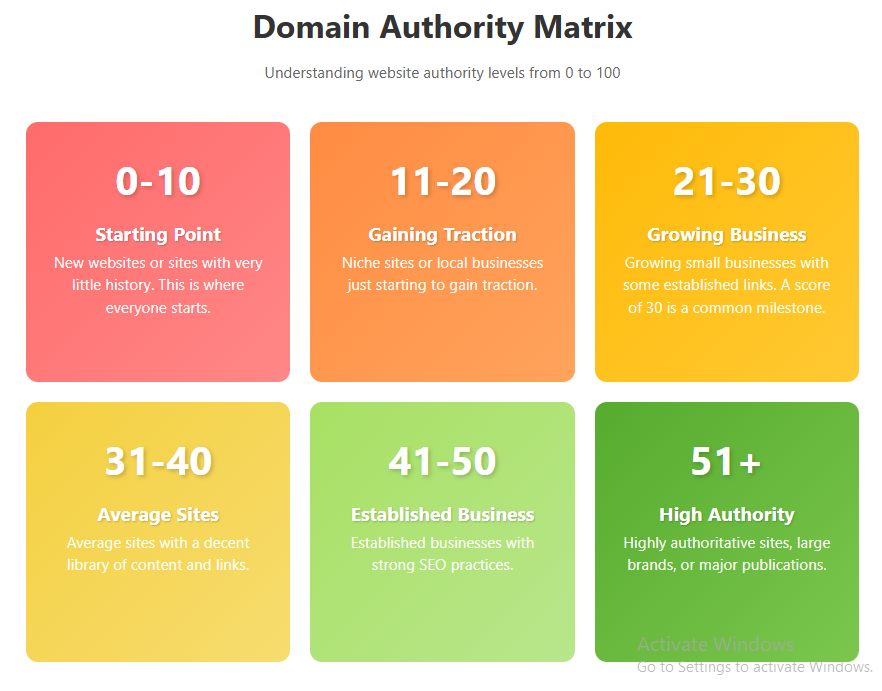
To give you a high-level overview based on your industry and market, here is a general breakdown of how scores are typically viewed:
- 0-10: New websites or sites with very little history. This is where everyone starts.
- 11-20: Niche sites or local businesses just starting to gain traction.
- 21-30: Growing small businesses with some established links. A score of 30 is a common milestone.
- 31-40: Average sites with a decent library of content and links.
- 41-50: Established businesses with strong SEO practices.
- 51+: Highly authoritative sites, large brands, or major publications.
Different domain scoring tools (like Moz, Semrush, or Ahrefs) use their own algorithms, so a “good” score on one might look different on another. However, they all generally operate on a grade scale where it is much easier to grow from 20 to 30 than it is to grow from 70 to 80.
Factors like backlinks, content quality, and SEO friendliness are the primary drivers of this score. If you sit on a stagnant site with no new links coming in, you may experience “Idle Domain Authority,” where your score drops not because you did something wrong, but because everyone else improved while you stood still.
Is 20 a good Domain Authority score?
Yes, 20 is a good Domain Authority score for a new website or a small local business.
While it might seem low on a scale of 100, context is key. If you are a local plumber and your competitors have scores of 8, 12, and 15, then a 20 is actually excellent. It suggests you have a stronger backlink profile than your direct rivals.
However, if you are trying to compete for high-volume, national keywords against major media outlets (who often have scores of 80+), a 20 will likely be insufficient to rank on the first page. At this level, your focus should be on targeting low-competition, long-tail keywords where your current authority is sufficient to win.
What is Domain Authority?
Domain Authority is a search engine ranking score developed by Moz that predicts how likely a website is to rank in search engine result pages (SERPs).
It is critical to clarify that Domain Authority is not a metric used by Google in determining search rankings and has no effect on the SERPs. It is a third-party metric. Think of it as a thermometer, not the thermostat. It measures the temperature (your site’s strength), but it doesn’t set it.
Scores range from one to 100, with higher scores corresponding to a greater ability to rank. The metric was created to simulate Google’s PageRank algorithm, which was the original foundation of how Google decided which pages were important. While Google has moved far beyond simple link counting, metrics like DA remain useful for SEOs to gauge the relative strength of a site’s backlink profile compared to others.
Why is Domain Authority important for SEO?
Domain Authority is important for SEO because it serves as a comparative tool to assess your site’s competitiveness against other sites in your niche.
Since Google does not reveal its internal ranking scores, SEO professionals need a proxy to understand why one site ranks higher than another. DA fills that gap.
If you are trying to decide which keywords to target, checking the DA of the sites currently ranking on page one is a smart first step. If the top 10 results are all occupied by sites with a DA of 80+, and your site has a DA of 25, you know that keyword is likely out of reach for now. This saves you time and resources by directing your content strategy toward keywords you can actually win.
Additionally, monitoring your DA over time acts as a health check for your link-building efforts. If you are actively building links but your score (and your competitors’ scores) remains flat or drops, it indicates your strategy may need adjustment.
What are the Facts About Domain Authority?
The facts about Domain Authority reveal that it is a logarithmic, relative, and fluctuating metric rather than a static grade.
To truly use DA effectively, you need to separate the myths from the reality. Here are the core facts:
- It is Logarithmic: This means the difficulty of increasing your score gets harder as the score gets higher. Jumping from DA 10 to DA 20 is significantly easier than jumping from DA 70 to DA 80.
- It is Relative: Your score can go down even if you didn’t lose any links. If a massive site like Facebook gains a billion new links, the “scale” might shift to accommodate that growth, slightly lowering the scores of smaller sites.
- It is not a Google Metric: We cannot stress this enough. Increasing your DA does not automatically increase your rankings. It correlates with rankings because high-ranking sites usually have good links (which DA measures), but it is not a cause-and-effect relationship.
- It fluctuates: Scores can change frequently as the tool provider updates its link index. A sudden drop doesn’t always mean you’ve been penalized; it might just mean the crawler hasn’t seen your newest links yet.
How is Domain Authority Calculated?
Domain Authority is calculated by evaluating multiple factors, including linking root domains and the number of total links, into a single DA score.
The calculation is complex and uses a machine learning model to find the “best fit” algorithm that correlates with rankings across thousands of actual search results.
Here is a breakdown of the primary components:
- Linking Root Domains: This is the most influential factor. It refers to the number of unique websites that link to you. Getting 10 links from 10 different websites is far more valuable than getting 100 links from a single website.
- Total Number of Links: The sheer volume of links matters, though quality is preferred over quantity.
- MozRank and MozTrust: These are older metrics that look at link popularity and the trustworthiness of the linking sites (e.g., links from government sites or universities carry more trust).
- Spam Score: If the sites linking to you are spammy or low-quality, it can negatively impact your ability to grow your authority.
Because the calculation is machine-learning-based, it is constantly evolving. As Google changes how it values links, tools like Moz update their calculations to keep their predictions accurate.
How can I increase my Domain Authority?
You can increase your Domain Authority by acquiring high-quality backlinks from reputable websites and removing toxic links.
There is no “easy button” for increasing DA. It requires a long-term strategy focused on value. Here is how to move the needle:
- Create Link-Worthy Content
This is the most sustainable method. Publish original research, comprehensive guides, or controversial opinion pieces that people in your industry want to reference. If you provide the data, others will cite you as the source. - Audit Your Link Profile
Use SEO tools to identify “toxic” or spammy links pointing to your site. While Google is generally good at ignoring these, a massive amount of spam can drag down your metrics. You can disavow these links through Google Search Console. - Guest Posting
Contribute high-quality articles to other authoritative blogs in your niche. This earns you a link back to your site and exposes your brand to a new audience. However, avoid “link farms” or sites that exist solely to sell guest posts, as these carry little value. - Broken Link Building
Find broken links on other websites in your industry. Reach out to the webmaster, let them know about the broken link, and suggest your own relevant content as a replacement. It’s a win-win: they fix their site, and you get a link. - Improve Internal Linking
While DA is mostly about external links, a strong internal linking structure helps search bots crawl your site more effectively. It ensures that the “link juice” you receive from external sources is distributed evenly throughout your pages.
How To Win with a Low Authority Score?
To win with a low authority score, you must target low-competition keywords and focus on topical relevance rather than broad authority.
Having a low DA doesn’t mean you can’t rank; it just means you can’t rank for everything. Here is the strategy for “underdog” websites:
Target Long-Tail Keywords
Instead of trying to rank for “running shoes” (which is dominated by Nike and Amazon), try ranking for “best running shoes for flat feet in rainy climates.” The search volume is lower, but the competition is weak, and the intent is high.
Build Topical Authority
Google values expertise. If you can’t be the authority on “finance,” be the absolute authority on “budgeting apps for college students.” Create a cluster of 20-30 articles covering every single angle of that specific sub-topic. Google will eventually recognize you as an expert in that narrow field, often ranking you above high-DA generalist sites.
Focus on User Experience (UX)
If you can’t beat them on links, beat them on experience. Make sure your site is faster, easier to read, and more helpful than the big competitors. Google’s “Helpful Content” updates have increasingly prioritized user satisfaction over raw link metrics.
Leverage Local SEO
If you are a local business, optimize your Google Business Profile and get local citations. You can dominate the “Map Pack” results without having a high Domain Authority, bypassing the organic results entirely.
In the world of SEO, an obsession with a single number can be a distraction. Domain Authority is a useful benchmark, but it is not the goal. The goal is traffic, engagement, and revenue.
Use DA to check your pulse and spy on your competitors, but don’t let a low number discourage you. By focusing on creating genuinely helpful content and building relationships within your industry, your authority and your rankings will naturally follow.